The arm as a lever: the biceps beats the load
A forearm holds 1 kg and 3 kg in the hand. The muscle attaches close to the elbow, so it pulls several times harder than the load weighs.
2D
Age 9+10 min
Levers & balanceElasticity
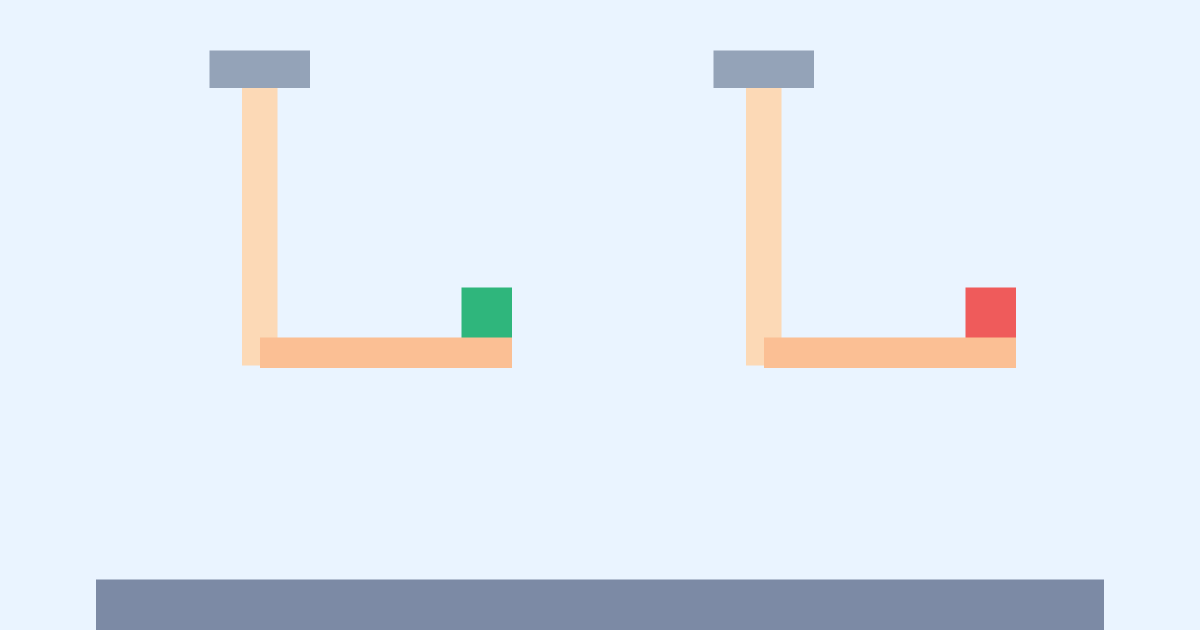
Loading simulation…
Press “Run”. Bodies move by the laws of physics: gravity, friction, elasticity.
What the experiment shows
The forearm is a lever with its fulcrum at the elbow; the muscle pulls close to the fulcrum and the load is far away. So the muscle must pull far harder than the weight of the load.
How to run it
- Press “Run”: both arms hold the load and the muscle spring stretches.
- Compare the muscle stretch with 1 kg and 3 kg.
- Move the muscle attachment farther from the elbow and see how the stretch changes.
Questions to discuss
- How many times larger is the muscle force than the weight of the load?
- Which is better: attaching the muscle nearer to or farther from the elbow?
The science
Balance of torques about the elbow: F_muscle · d = m·g·L. With the attachment 40 cm from the elbow and the hand 190 cm away, the muscle pulls about 4–5 times the weight. In return, a small contraction gives a large hand movement.
Try it at home
Bend your arm and feel your biceps tendon with the other hand near the elbow — it attaches very close to the joint.
What to change in the editor
- Make the muscle stiffer (k = 400).
- Put 5 kg in the hand.