Billiards: collisions and momentum
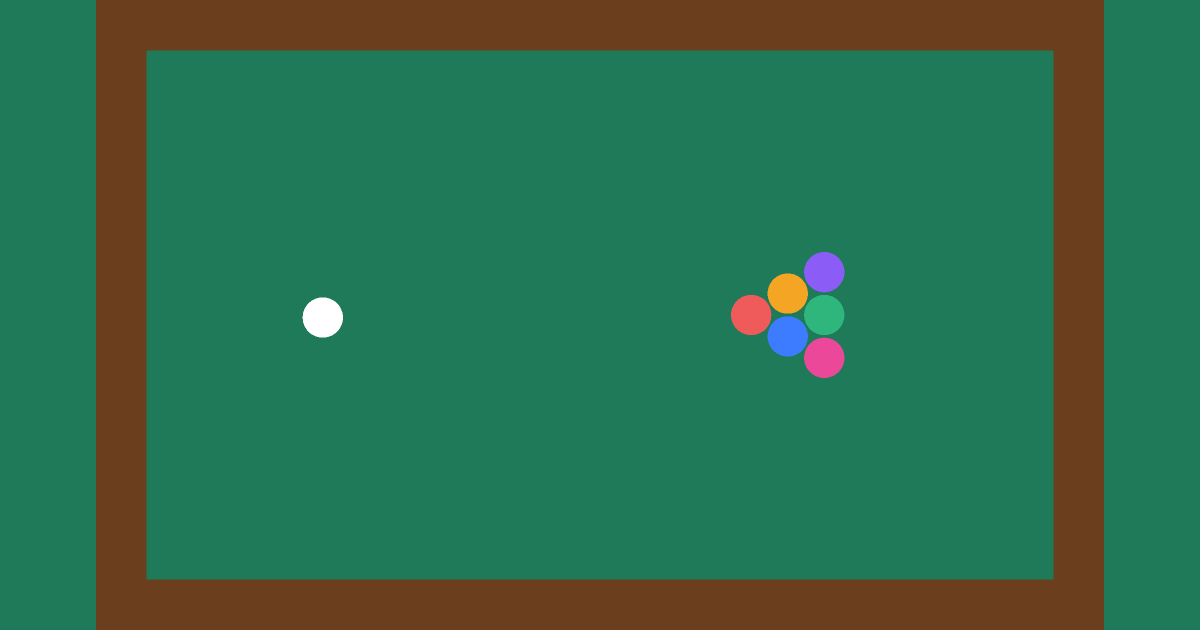
A cue ball breaks a rack on a top-down table. Momentum passes from ball to ball — a collision experiment for kids 8+.
2D
Age 8+10 min
Momentum & collisionsFriction
Loading simulation…
Press “Run”. Bodies move by the laws of physics: gravity, friction, elasticity.
What the experiment shows
A cue ball is shot at a rack of six balls. After the hit they all scatter and the cue ball nearly stops — part of its momentum went to the others.
How to run it
- Press “Run” and follow the balls’ paths.
- Raise the cue ball’s speed in the editor — how does the scatter change?
- Make the cue ball twice as heavy.
Questions to discuss
- Why do the balls stop on their own?
- Where did the cue ball’s momentum go?
The science
The total momentum of the balls is conserved in a collision: m₁v₁ = m₁v₁′ + Σmv. An elastic collision also conserves energy. Afterwards friction with the cloth slows the balls to a stop.
Try it at home
Flick a coin into a group of coins on a smooth table and watch how they scatter.
What to change in the editor
- Reduce the balls’ elasticity — the hit becomes softer.
- Add more balls to the rack.