A car’s suspension on bumps
Two identical cars drive over two bumps. The green one has springs only, the red one springs and shock absorbers: the red body settles quickly.
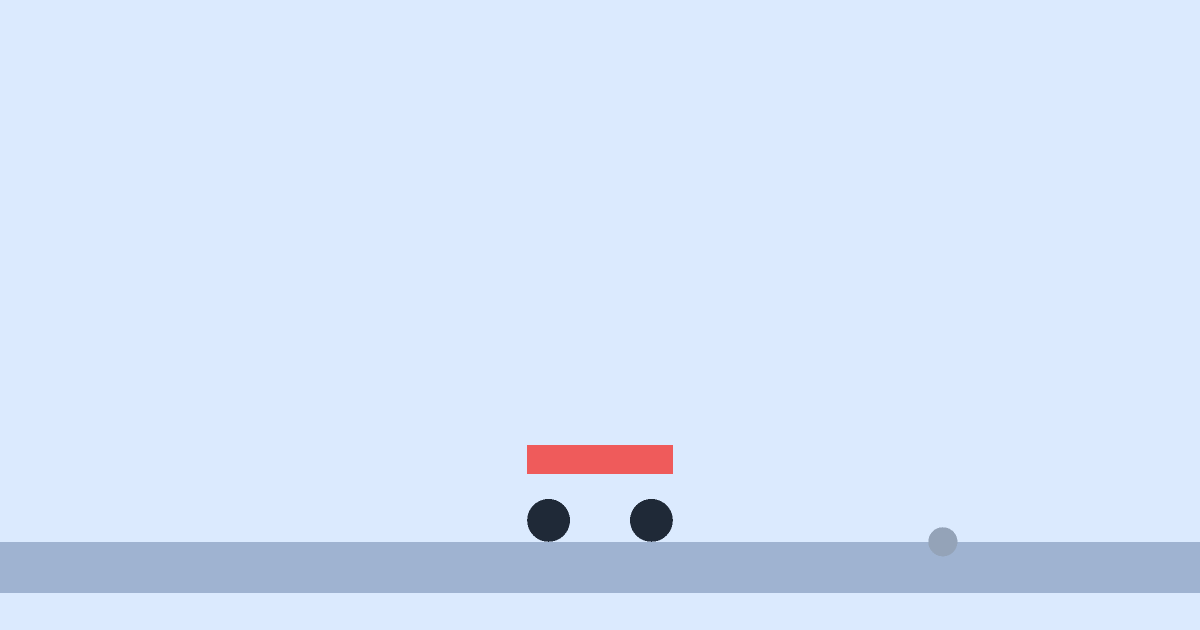
Drag to orbit the scene, scroll to zoom. Press “Run”.
What the experiment shows
A spring softens the wheel’s hit on a bump but swings by itself. The shock absorber damps the swinging: the body bobs once or twice and settles.
How to run it
- Press “Run” and watch the bodies over the first bump.
- Compare how many times each body bobbed after the bump.
- Select a spring and change the damping d: find the value where the body does not bob at all.
Questions to discuss
- Why does a car without shock absorbers “float” on a bumpy road?
- Why does a wheel need a suspension if the tyre is elastic too?
The science
A body on springs is an oscillator with ω = √(k/m). Here each of four springs with k = 1250 N/m carries 20 kg, so ω ≈ 8 rad/s. Without a damper the swinging dies out very slowly. A shock absorber produces a force proportional to speed that takes the energy of the oscillation and turns it into heat.
Try it at home
Press down on the hood of a parked car and let go: with healthy shock absorbers it bounces once. A quick check mechanics really use.
What to change in the editor
- Make the springs stiffer (k = 5000) — how does the body behave?
- Raise the cars’ speed to 5 m/s.