The eye and glasses: fixing short-sightedness
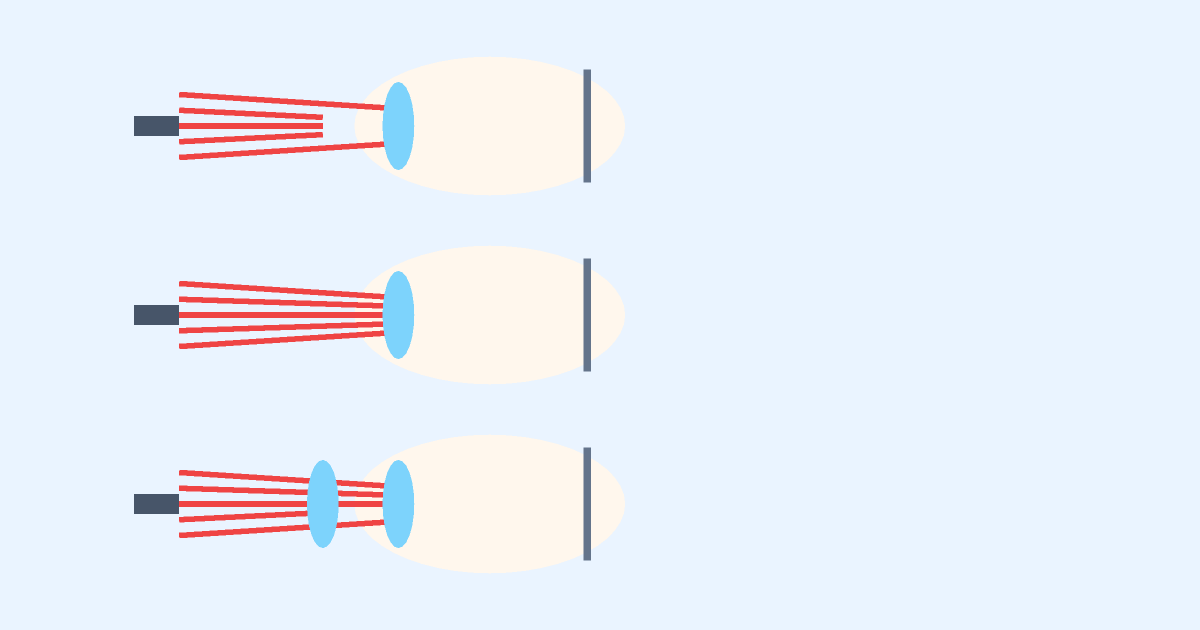
Three eye models: normal, short-sighted and short-sighted with glasses. Rays meet on the retina only in the normal eye and in the eye with a diverging lens.
Press “Run”. Bodies move by the laws of physics: gravity, friction, elasticity.
What the experiment shows
The lens gathers rays from a distant object to a point. In a normal eye that point lies on the retina. In a short-sighted eye the lens is “too strong”: the focus falls inside the eye and the image is blurred. A diverging spectacle lens pushes the focus back.
How to run it
- Look at the three eyes: do the rays meet before the retina, on it or behind it?
- Select the spectacle lens and change its focal length (f = −430): the focus moves away from the retina.
- Select the normal eye’s lens and set f = 115 — it becomes short-sighted.
Questions to discuss
- Why do short-sighted people need diverging lenses?
- Which glasses would a long-sighted person need — converging or diverging?
The science
The eye’s lens is converging. A short-sighted eye has too much optical power (or is too long), so its focus (f = 115) falls in front of the retina (150). A diverging lens with f = −430 reduces the total power and shifts the focus onto the retina. A lens’s optical power is D = 1/f (in dioptres when f is in metres): positive for converging, negative for diverging.
Try it at home
If someone at home has glasses for short-sightedness, look through them at some text: the lens is thinner in the middle than at the edges and everything looks smaller. A magnifying glass is the opposite — thicker in the middle.
What to change in the editor
- Add a fourth eye — long-sighted (f = 190) — and find converging glasses for it.
- Move the glasses closer to the eye — how does the focus shift?