Home wiring: each lamp has its own switch
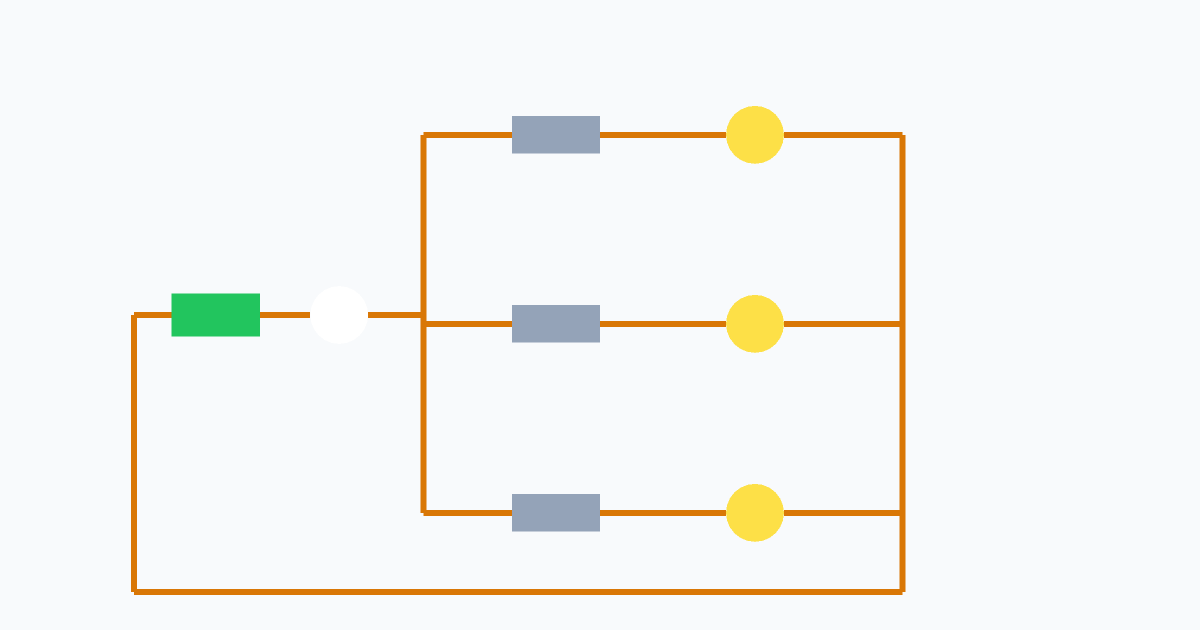
Three lamps are wired in parallel, each with its own switch. Click them — the other lamps keep glowing as before.
2D
Age 8+10 min
ElectricityLogic & robots
Loading simulation…
Press “Run”. Bodies move by the laws of physics: gravity, friction, elasticity.
What the experiment shows
At home all appliances are connected in parallel to the mains: each gets the full voltage and switches on independently.
How to run it
- Press “Run”: the middle lamp is off.
- Click the switches and watch the ammeter.
- Does the total current grow with more lamps on?
Questions to discuss
- Why don’t the others go out when one lamp burns?
- Why is there a breaker in the panel when too many appliances are on?
The science
In a parallel circuit every branch has the same voltage while branch currents add: I = I₁ + I₂ + I₃. Each new appliance increases the current in the main wire.
Try it at home
Find the electrical panel at home (don’t open it!) and ask an adult which rooms are on which breaker.
What to change in the editor
- Add a fourth lamp.
- Wire the lamps in series and compare.