A lever: a child lifts a heavy stone
A 20 kg load on the long arm lifts a 50 kg stone when the fulcrum is close to the stone. With the fulcrum in the middle the stone stays put.
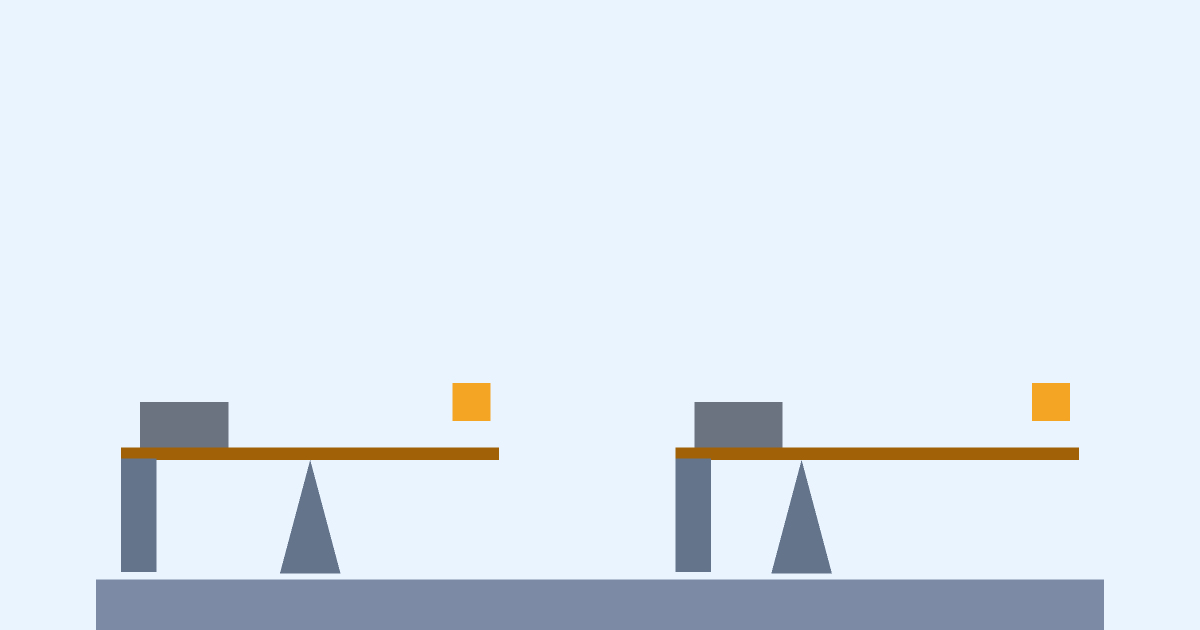
Press “Run”. Bodies move by the laws of physics: gravity, friction, elasticity.
What the experiment shows
A lever gives a gain in force: the longer the arm you push and the shorter the arm at the load, the less force you need. You pay in distance: the long end moves far more than the stone rises.
How to run it
- Press “Run”: on the left the fulcrum is in the middle, on the right it is close to the stone.
- Compare what happens to the stone on the left and on the right.
- Move the left fulcrum closer to the stone and repeat.
Questions to discuss
- How many times longer is the long arm on the right than the short one?
- How far did the lever end go down and how far did the stone rise?
The science
The lever balances when F₁·l₁ = F₂·l₂ (torques are equal). On the right the load’s 20 kg · 178 cm = 3560 beats the stone’s 50 kg · 50 cm = 2500. On the left 20 kg · 128 cm = 2560 is less than 50 kg · 120 cm = 6000, so the stone stays.
Try it at home
Rest a ruler on a pencil and put a heavy book on one end. Press the other end — the closer the pencil is to the book, the easier it lifts.
What to change in the editor
- Move the fulcrum even closer to the stone — will a 10 kg child do?
- Change the stone’s mass.