Refraction of light: glass and a prism
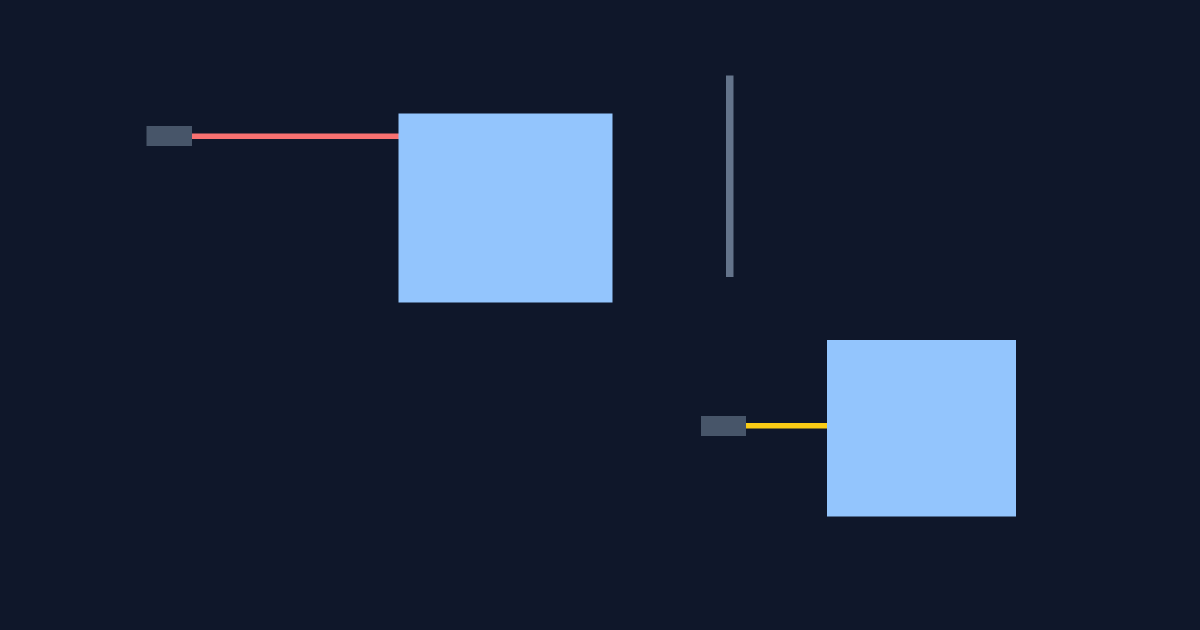
A ray enters a glass block and a prism, changes direction and leaves. The angle of refraction obeys Snell’s law.
2D
Age 10+10 min
Light & optics
Loading simulation…
Press “Run”. Bodies move by the laws of physics: gravity, friction, elasticity.
What the experiment shows
At the air–glass boundary the ray bends toward the normal inside the glass. A flat slab sends it out parallel to the original ray while a prism turns it.
How to run it
- Look at the rays in the block and in the prism.
- Select a laser and rotate it — watch the angles.
- Set the block’s refractive index to 2: the ray bends more.
Questions to discuss
- Why does a spoon in a glass of water look broken?
- Where does a rainbow come from?
The science
Snell’s law: n₁·sin θ₁ = n₂·sin θ₂. The higher the refractive index n, the slower light travels and the more the ray bends toward the normal. At large angles inside glass total internal reflection is possible.
Try it at home
Shine a torch at an angle into a fish tank or a glass of water and see the ray change direction.
What to change in the editor
- Add a mirror to send the ray back.