Seesaw lever: the balance rule
A heavy load close to the pivot balances a light one far away. An interactive lever model for kids 8+: torque and balance.
2D
Age 8+15 min
Levers & balanceStability
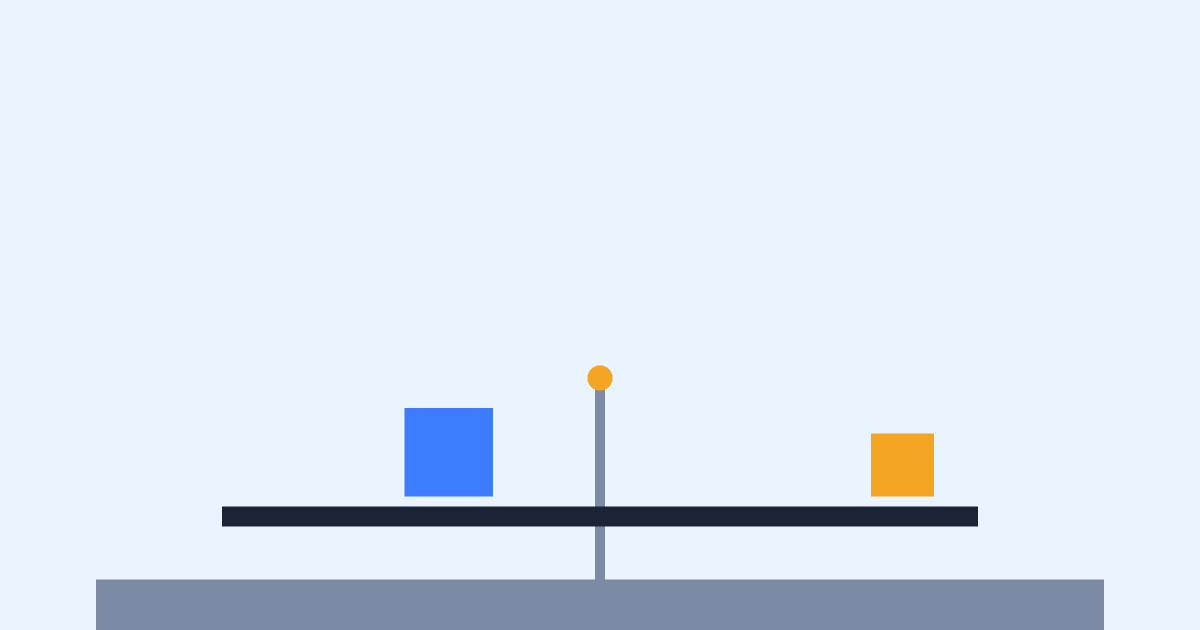
Loading simulation…
Press “Run”. Bodies move by the laws of physics: gravity, friction, elasticity.
What the experiment shows
Two loads sit on a plank: 2 kg at 1.2 m and 1 kg at 2.4 m from the pivot. The torques are equal (2 × 1.2 = 1 × 2.4), so the seesaw is balanced.
How to run it
- Press “Run” and watch the seesaw hold its balance.
- In the editor move the light load closer to the center and run again — the plank tips toward the heavy one.
- Find a position that balances the seesaw again.
Questions to discuss
- How can a small child balance an adult on a seesaw?
- Where else do we use levers — scissors, door handles, wheelbarrows?
The science
Torque equals force times arm (distance to the pivot). A lever is balanced when the torques on both sides match: m₁·l₁ = m₂·l₂. A light load on a long arm balances a heavy one on a short arm.
Try it at home
Lay a ruler across a pencil and put coins on it. Two coins on the short arm balance one on the long arm. Measure the arms and check the formula.
What to change in the editor
- Change the loads’ masses while keeping m·l equal.
- Add a third load and find the balance.