Galton board: a bell curve from chance
Balls fall through rows of pegs and pile up in a bell shape. Hands-on probability and the normal distribution for kids 9+.
2D
Age 9+10 min
ProbabilityGravity
Loading simulation…
Press “Run”. Bodies move by the laws of physics: gravity, friction, elasticity.
What the experiment shows
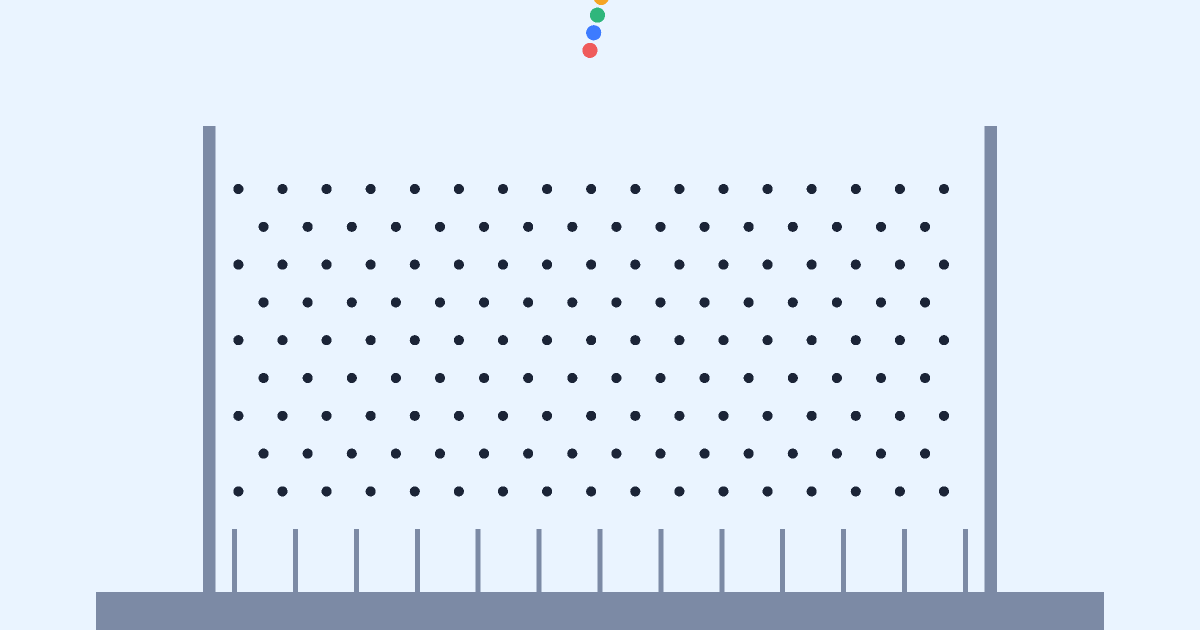
At every peg each ball bounces left or right. Paths differ, but the middle bins collect more balls than the edges.
How to run it
- Press “Run” and watch the balls fill the bins.
- Compare the column heights: where are the most balls?
- In the editor make the balls bouncier — the picture gets wider.
Questions to discuss
- Why are the outer bins almost empty?
- What changes if you add another row of pegs?
The science
Reaching the edge needs one very specific sequence — every bounce the same way — while the center can be reached in many ways. A sum of many random left/right steps gives a normal (bell-shaped) distribution.
Try it at home
Toss 10 coins 50 times and record the number of heads: the columns form a bell too.
What to change in the editor
- Change the peg spacing.
- Add more balls.