The Tymora logo in 20 frames: twenty kinds of physics
One project, 20 frames, each with the Tymora logo and its own physics: Moon, zero gravity, ice, pendulum, spring, water, dominoes and more.
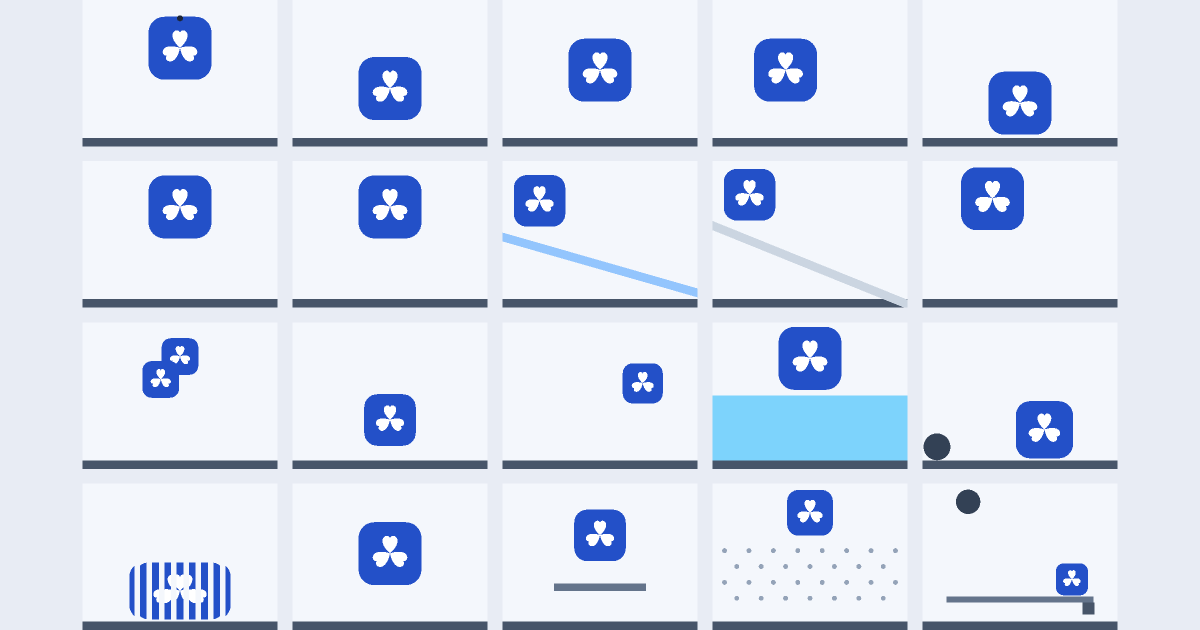
Press “Run”. Bodies move by the laws of physics: gravity, friction, elasticity.
What the experiment shows
Twenty frames run at the same time, each with its own conditions: gravity, bounce, friction, hinges, springs, water and “if, then” rules. The logo is cut into tiles, and every tile is a masked group with its own physical body. It is a showcase of what the Tymora physics engine can do.
How to run it
- Press “Run”: all 20 frames start at once.
- Select one frame and run it alone, then change gravity, mass, friction or bounce.
- Copy a frame you like and put your own logo in place of ours.
Questions to discuss
- How is a fall on the Moon different from a fall on Earth, and why do the tiles not weigh the same?
- Why do some tiles float in the water frame while others sink?
The science
The Rapier engine computes collisions, friction, bounce, joints and springs, and the fluid adds buoyancy. Each frame changes one condition, so it is easy to see what it does: gravity changes acceleration, bounce changes rebound, friction changes sliding, density decides float or sink.
Try it at home
Try at home: drop a tennis ball and a clay ball, slide a coin down a book and down a piece of ice, hang a weight on a thread and on a rubber band.
What to change in the editor
- In the Ice frame set the tiles friction to 1: they stop sliding.
- In the Water frame make all tiles light: the whole logo floats up.