A pedestrian and a cyclist, catching up
A pedestrian sets off first and a cyclist follows. Find the time the cyclist needs to catch up.
2D
Age 10+10 min
Motion problems
Loading simulation…
Press “Run”. Bodies move by the laws of physics: gravity, friction, elasticity.
What the experiment shows
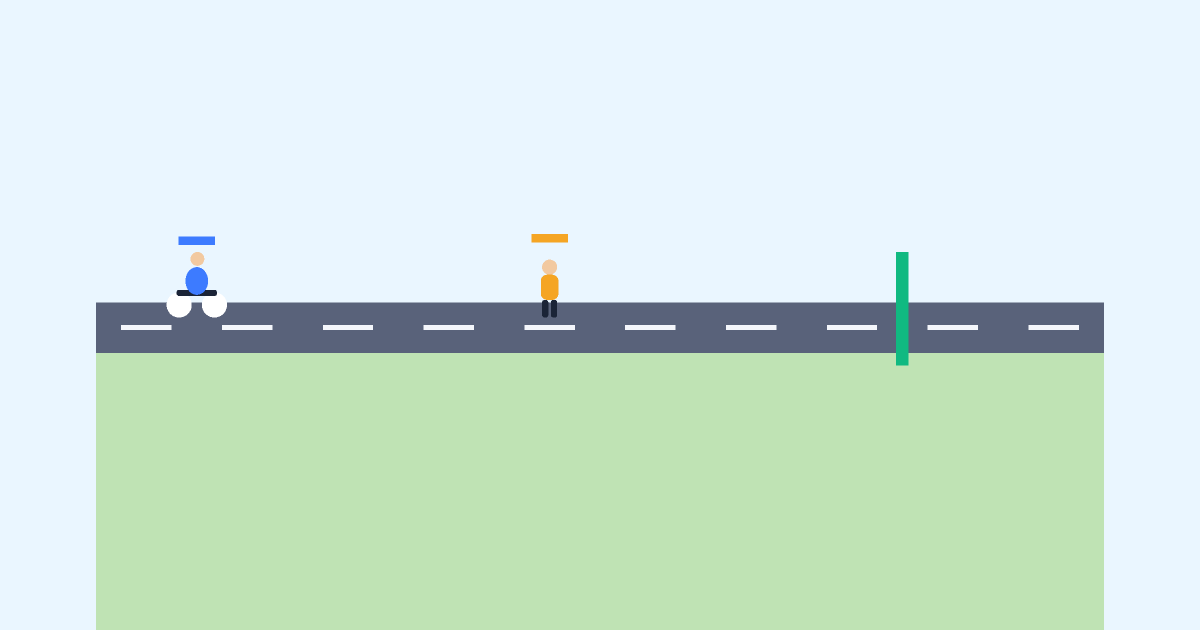
The pedestrian is ahead and the faster cyclist starts later from the same point. The scene picks its own scale so the meeting stays on screen.
How to run it
- Run the scene: the chaser gets closer and the S caption shows the gap.
- Enter your answer in the Task panel and press “Check”.
- Change the speeds or the head start with the sliders: will the fast one catch up sooner or later?
Questions to discuss
- Why does the gap shrink by the difference of the speeds, not the sum?
- What happens if the speeds are almost equal?
The science
While one moves ahead the other chases: every hour the head start shrinks by the difference of the speeds, the closing speed in a chase. The chase time is t = head start / (v₂ − v₁).
Try it at home
Let a friend start 10 steps ahead while you walk a bit faster: how many steps do you need to catch up?
What to change in the editor
- Open the example in the editor and add a third participant who leaves even later.
- Swap the speeds so that catching up is impossible and explain why.