Workshop: piston, spring and chain
A piston on key P, a weight on a spring and a ball on a chain in one 3D scene. Mechanics for kids 9+.
3D
Age 9+15 min
Machines & mechanismsOscillations3D scene
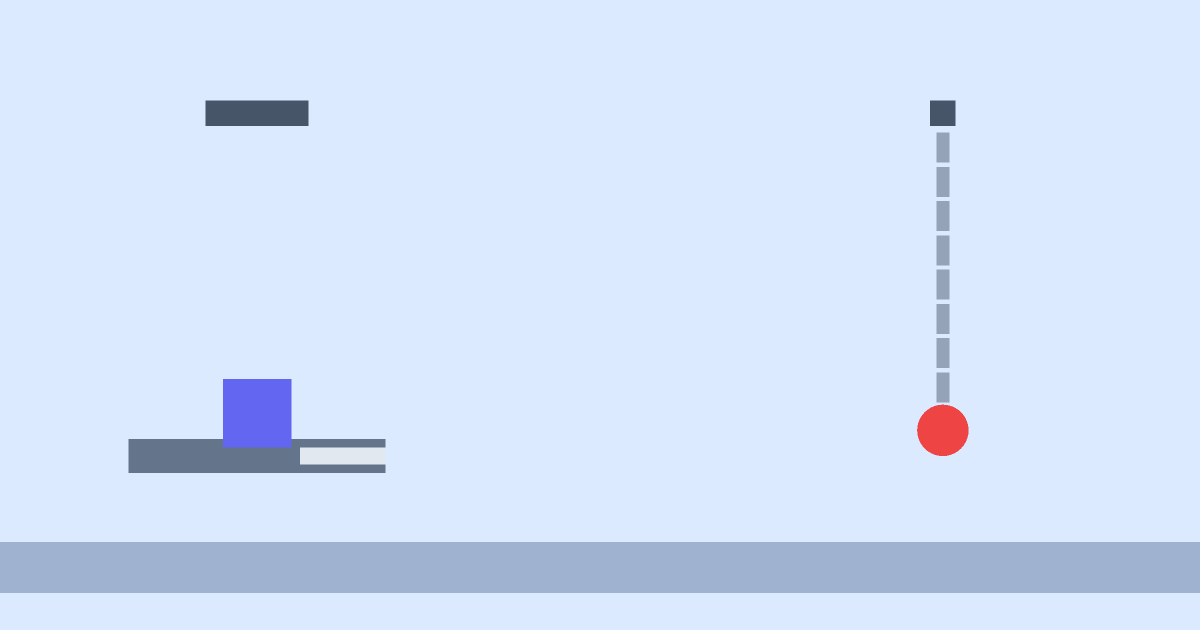
Loading simulation…
Drag to orbit the scene, scroll to zoom. Press “Run”.
What the experiment shows
The piston is a linear actuator with a 1 m stroke. The spring weight oscillates around its rest position and the chain of hinged links acts like a flexible rope.
How to run it
- Run the example: the weight starts bobbing on the spring and the ball swings on the chain.
- Press P — the piston rod extends; release it and it returns.
- Change the spring stiffness k: the larger k, the faster the oscillation.
Questions to discuss
- How does the oscillation period depend on the weight’s mass?
- Why does a chain sag into a curve?
The science
A spring force F = −k·x pulls the weight back to equilibrium, so it oscillates with period T = 2π√(m/k). A chain is a set of links connected by hinges: each part pulls the neighbours and the whole chain takes the shape with the lowest potential energy.
Try it at home
Hang a weight on a rubber band and measure how the period changes with different weights. Hang a necklace by its ends — it forms a catenary curve.
What to change in the editor
- Add more links to the chain.
- Give the piston another key.