Why a pyramid is stable and a tower is not
The platform sways from side to side. A tower of ten cubes falls almost at once while a pyramid of ten cubes stands.
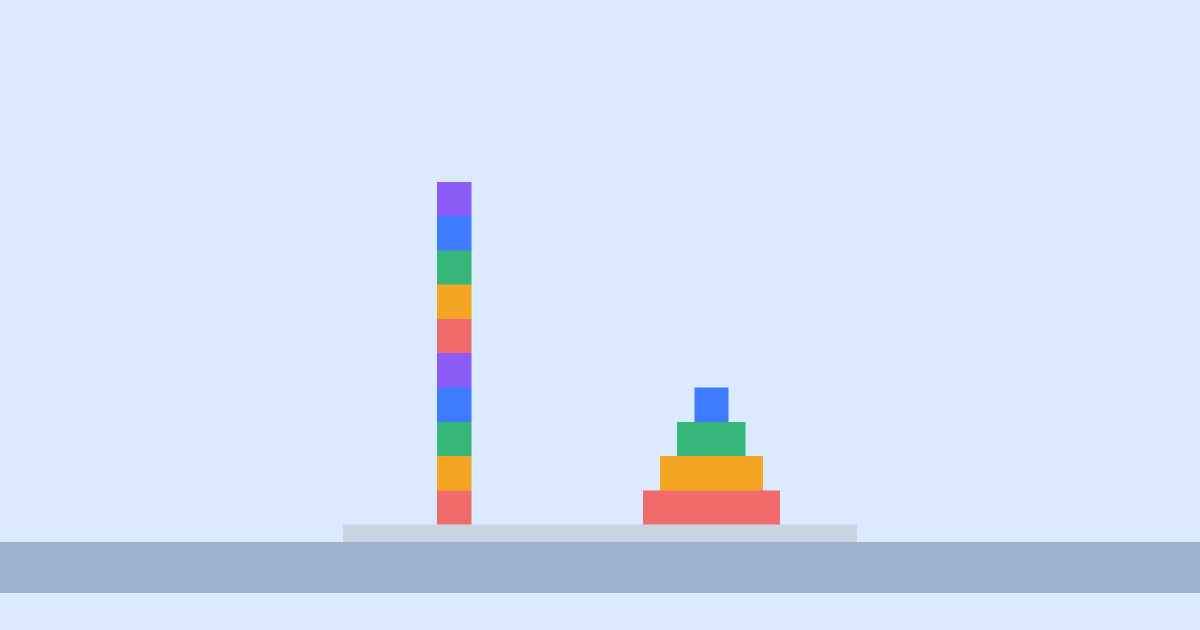
Drag to orbit the scene, scroll to zoom. Press “Run”.
What the experiment shows
Stability depends on the shape: a pyramid has a low centre of mass and a wide base. The platform must be moved far more sharply to topple it than to topple a tower.
How to run it
- Press “Run”: the platform starts swaying.
- Watch: which structure falls first?
- Select the platform’s joint and increase the drive stiffness — will the pyramid fall too?
Questions to discuss
- Why have the Egyptian pyramids stood for thousands of years?
- How can a tower be made more stable without changing the number of cubes?
The science
A structure tips when the base acceleration exceeds g·(b/2)/h, where b is the base width and h the height of the centre of mass. Tower: b = 0.4 m, h = 2 m, threshold about 1 m/s². Pyramid: b = 1.6 m, h ≈ 0.6 m, threshold about 13 m/s², and before that the cubes would start sliding on friction. The mass is the same, its distribution is not.
Try it at home
Build a tower and a pyramid from the same number of blocks and shake the table. Which one collapses?
What to change in the editor
- Build a pyramid of five rows.
- Make the cubes slippery (friction 0.1) — how does the pyramid change?