Robot vacuum: rules and touch sensors
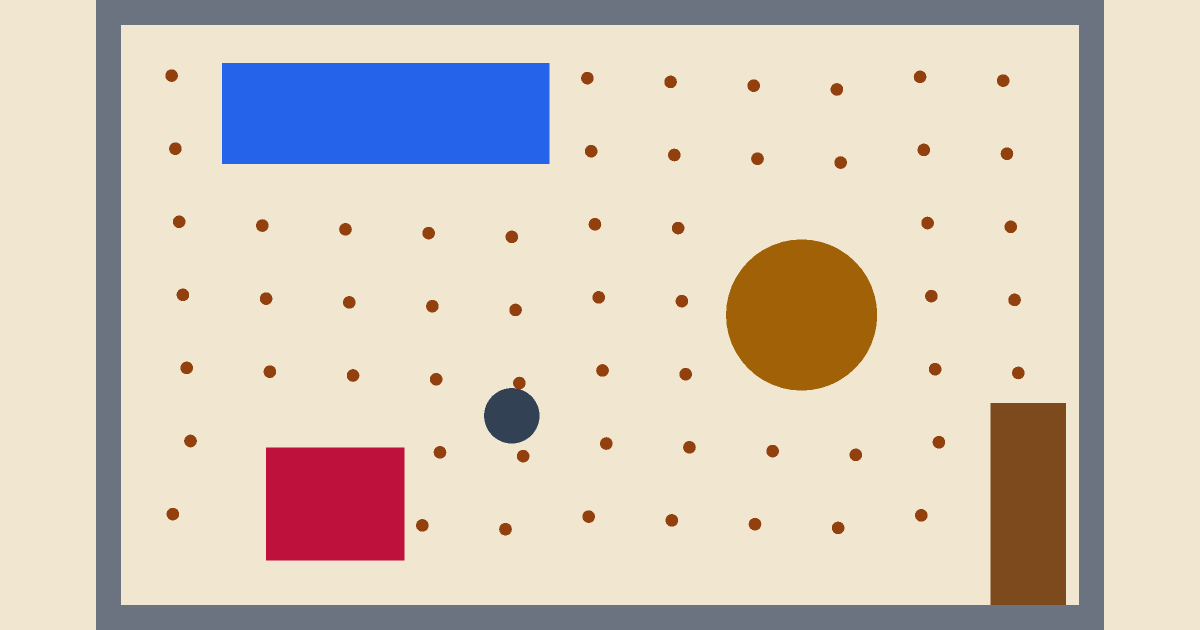
A top view: the robot bounces off furniture and picks up crumbs. A touch sensor removes each crumb and timer rules change its course.
2D
Age 8+15 min
Logic & robotsMomentum & collisions
Loading simulation…
Press “Run”. Bodies move by the laws of physics: gravity, friction, elasticity.
What the experiment shows
A robot vacuum can’t see the whole room: it drives, bumps into an obstacle and turns away. Sensors and simple “if — then” rules let it clean most of the room.
How to run it
- Press “Run” and watch the crumbs disappear.
- Open the “Logic” tab: find the timed turn rules and the crumb sensors.
- Add another turn rule at the 36 second mark.
Questions to discuss
- Which spots does the robot clean worst? Why?
- How could it avoid getting stuck behind the sofa?
The science
A simple robot has no map: it drives straight and bounces elastically on contact. Random bounces and occasional timed turns cover the room, though not perfectly. The longer it runs, the more it covers — an example of a random walk.
Try it at home
Put a few boxes on the floor and push a toy car around: it never covers everything, but touches a lot.
What to change in the editor
- Make the robot faster.
- Rearrange the furniture to create dead ends.